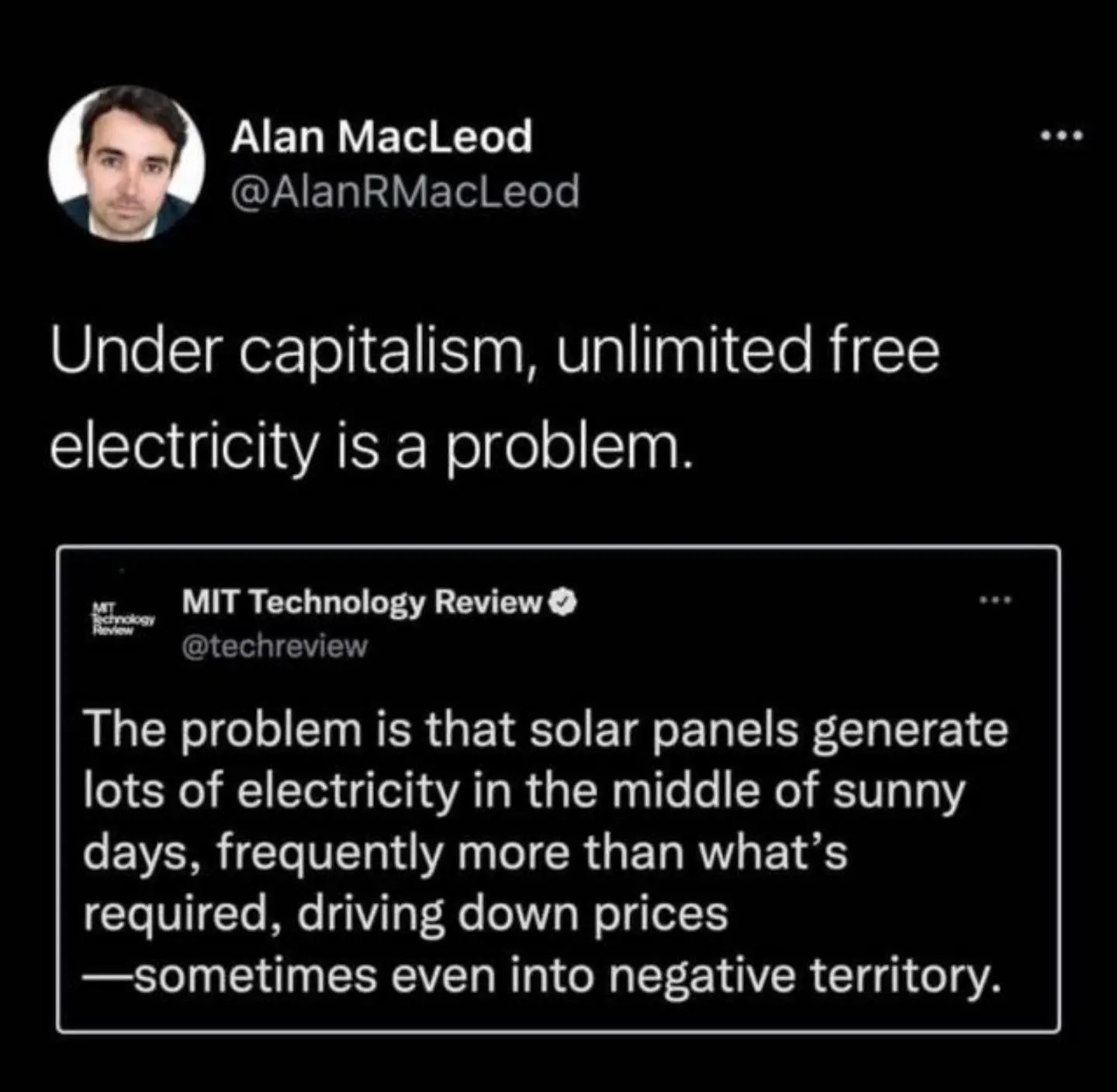
▲ 1669 ▼ consider the implications for a post scarcity future (slrpnk.net) submitted 2 years ago by stabby_cicada@slrpnk.net to c/solarpunk@slrpnk.net 386 comments fedilink hide all child comments
[–] thisbenzingring@lemmy.sdf.org 32 points 2 years ago (12 children) We need natural batteries like solar power lifting water from a lake into a reservoir so that when we need that energy and the sun isn't making it, released water does permalink fedilink source hideshow 12 child comments replies: [–] jol@discuss.tchncs.de 26 points 2 years ago (6 children) A cubic meter of water above your roof has the storing capacity of a AAA cell. That's why you need huge, massive damms to store any significant amount of power. But unfortunately it's not flexible enough (you need mountains nearby) or dense enough. permalink fedilink source parent hideshow 6 child comments replies: [–] Semi_Hemi_Demigod@lemmy.world 5 points 2 years ago There are already companies making thermal storage systems to store excess energy. They heat sand up to about 500 degrees when there's excess power and then convert it back to electricity or just use the heat directly for heating water or living spaces. There's also companies (googles do nothing but link to YouTube videos) working on scaling this down to about the size of a water heater. permalink fedilink source parent [–] antrosapien@lemmy.ml 3 points 2 years ago (4 children) What about storing energy as potential energy using some high density objects. This may work.. Right?? gravitricity Check out their work. permalink fedilink source parent hideshow 4 child comments replies: [–] amelore@slrpnk.net 3 points 2 years ago* Yes, suspended weights, also spinning flywheels, hot salt, hot sand There's options besides pumped hydro, hydrogen and batteries permalink fedilink source parent [–] jol@discuss.tchncs.de 3 points 2 years ago It's slithly better the more dense the material, but that's basically the same thing. You could say that depending on the location, using water is much more practical. A much more interesting one I saw was the molten salt ones, where basically you store the energy as heat in a sealed place, and then when you need it, you use that heat to run turbines. permalink fedilink source parent [–] shaman1093@lemmy.ml 1 point 2 years ago Interesting concept, thanks for sharing permalink fedilink source parent [–] capital@lemmy.world 1 point 2 years ago I don’t think it’s feasible. https://youtu.be/XxGQgAr4OCo permalink fedilink source parent [–] ProvableGecko@lemmy.world 18 points 2 years ago* (4 children) Yes this exists and it's called pumped storage hydroelectricity permalink fedilink source parent hideshow 4 child comments replies: [–] sicarius@lemmy.world 10 points 2 years ago* (2 children) I did some work at a place called The hollow mountain that does this. But seeing as it looked like an underground James Bond bad guy base and I was a rope access mook in a boiler suit, I felt like I could die at any moment by tuxedo clad hero. It wasn't solar they used to power pump the water back up though. They just, hmm I want to say, bought cheap electricity when no one was using it. permalink fedilink source parent hideshow 2 child comments replies: [–] ProvableGecko@lemmy.world 4 points 2 years ago (1 child) This is the imperial base from Andor, right? Cool permalink fedilink source parent hideshow 1 child comment replies: [–] sicarius@lemmy.world 2 points 2 years ago Holeey sheet it is! I didn't know that! Thanks. permalink fedilink source parent [–] Zacryon@feddit.de 3 points 2 years ago With an energy conversion efficiency of usually 75 to 80 % they are really efficient and don't have as much energy loss as other types of energy storage. It's a simple, but powerful concept and I find it beautiful. However, there is some concern regarding their impact on the local ecosystem. Not only do they need huge water reservoirs, which are artificially created and therefore might impact nearby rivers and even fish migration, but the way they are sealed with concrete or asphalt also disallows the development of riparian vegetation. From an ecological perspective they are basically dead zones. Still, considering several alternatives, I think it's one of the better options. Although it's not cheap to build those, which is a problem in our current capitalitic society permalink fedilink source parent
[–] jol@discuss.tchncs.de 26 points 2 years ago (6 children) A cubic meter of water above your roof has the storing capacity of a AAA cell. That's why you need huge, massive damms to store any significant amount of power. But unfortunately it's not flexible enough (you need mountains nearby) or dense enough. permalink fedilink source parent hideshow 6 child comments replies: [–] Semi_Hemi_Demigod@lemmy.world 5 points 2 years ago There are already companies making thermal storage systems to store excess energy. They heat sand up to about 500 degrees when there's excess power and then convert it back to electricity or just use the heat directly for heating water or living spaces. There's also companies (googles do nothing but link to YouTube videos) working on scaling this down to about the size of a water heater. permalink fedilink source parent [–] antrosapien@lemmy.ml 3 points 2 years ago (4 children) What about storing energy as potential energy using some high density objects. This may work.. Right?? gravitricity Check out their work. permalink fedilink source parent hideshow 4 child comments replies: [–] amelore@slrpnk.net 3 points 2 years ago* Yes, suspended weights, also spinning flywheels, hot salt, hot sand There's options besides pumped hydro, hydrogen and batteries permalink fedilink source parent [–] jol@discuss.tchncs.de 3 points 2 years ago It's slithly better the more dense the material, but that's basically the same thing. You could say that depending on the location, using water is much more practical. A much more interesting one I saw was the molten salt ones, where basically you store the energy as heat in a sealed place, and then when you need it, you use that heat to run turbines. permalink fedilink source parent [–] shaman1093@lemmy.ml 1 point 2 years ago Interesting concept, thanks for sharing permalink fedilink source parent [–] capital@lemmy.world 1 point 2 years ago I don’t think it’s feasible. https://youtu.be/XxGQgAr4OCo permalink fedilink source parent
[–] Semi_Hemi_Demigod@lemmy.world 5 points 2 years ago There are already companies making thermal storage systems to store excess energy. They heat sand up to about 500 degrees when there's excess power and then convert it back to electricity or just use the heat directly for heating water or living spaces. There's also companies (googles do nothing but link to YouTube videos) working on scaling this down to about the size of a water heater. permalink fedilink source parent
[–] antrosapien@lemmy.ml 3 points 2 years ago (4 children) What about storing energy as potential energy using some high density objects. This may work.. Right?? gravitricity Check out their work. permalink fedilink source parent hideshow 4 child comments replies: [–] amelore@slrpnk.net 3 points 2 years ago* Yes, suspended weights, also spinning flywheels, hot salt, hot sand There's options besides pumped hydro, hydrogen and batteries permalink fedilink source parent [–] jol@discuss.tchncs.de 3 points 2 years ago It's slithly better the more dense the material, but that's basically the same thing. You could say that depending on the location, using water is much more practical. A much more interesting one I saw was the molten salt ones, where basically you store the energy as heat in a sealed place, and then when you need it, you use that heat to run turbines. permalink fedilink source parent [–] shaman1093@lemmy.ml 1 point 2 years ago Interesting concept, thanks for sharing permalink fedilink source parent [–] capital@lemmy.world 1 point 2 years ago I don’t think it’s feasible. https://youtu.be/XxGQgAr4OCo permalink fedilink source parent
[–] amelore@slrpnk.net 3 points 2 years ago* Yes, suspended weights, also spinning flywheels, hot salt, hot sand There's options besides pumped hydro, hydrogen and batteries permalink fedilink source parent
[–] jol@discuss.tchncs.de 3 points 2 years ago It's slithly better the more dense the material, but that's basically the same thing. You could say that depending on the location, using water is much more practical. A much more interesting one I saw was the molten salt ones, where basically you store the energy as heat in a sealed place, and then when you need it, you use that heat to run turbines. permalink fedilink source parent
[–] shaman1093@lemmy.ml 1 point 2 years ago Interesting concept, thanks for sharing permalink fedilink source parent
[–] capital@lemmy.world 1 point 2 years ago I don’t think it’s feasible. https://youtu.be/XxGQgAr4OCo permalink fedilink source parent
[–] ProvableGecko@lemmy.world 18 points 2 years ago* (4 children) Yes this exists and it's called pumped storage hydroelectricity permalink fedilink source parent hideshow 4 child comments replies: [–] sicarius@lemmy.world 10 points 2 years ago* (2 children) I did some work at a place called The hollow mountain that does this. But seeing as it looked like an underground James Bond bad guy base and I was a rope access mook in a boiler suit, I felt like I could die at any moment by tuxedo clad hero. It wasn't solar they used to power pump the water back up though. They just, hmm I want to say, bought cheap electricity when no one was using it. permalink fedilink source parent hideshow 2 child comments replies: [–] ProvableGecko@lemmy.world 4 points 2 years ago (1 child) This is the imperial base from Andor, right? Cool permalink fedilink source parent hideshow 1 child comment replies: [–] sicarius@lemmy.world 2 points 2 years ago Holeey sheet it is! I didn't know that! Thanks. permalink fedilink source parent [–] Zacryon@feddit.de 3 points 2 years ago With an energy conversion efficiency of usually 75 to 80 % they are really efficient and don't have as much energy loss as other types of energy storage. It's a simple, but powerful concept and I find it beautiful. However, there is some concern regarding their impact on the local ecosystem. Not only do they need huge water reservoirs, which are artificially created and therefore might impact nearby rivers and even fish migration, but the way they are sealed with concrete or asphalt also disallows the development of riparian vegetation. From an ecological perspective they are basically dead zones. Still, considering several alternatives, I think it's one of the better options. Although it's not cheap to build those, which is a problem in our current capitalitic society permalink fedilink source parent
[–] sicarius@lemmy.world 10 points 2 years ago* (2 children) I did some work at a place called The hollow mountain that does this. But seeing as it looked like an underground James Bond bad guy base and I was a rope access mook in a boiler suit, I felt like I could die at any moment by tuxedo clad hero. It wasn't solar they used to power pump the water back up though. They just, hmm I want to say, bought cheap electricity when no one was using it. permalink fedilink source parent hideshow 2 child comments replies: [–] ProvableGecko@lemmy.world 4 points 2 years ago (1 child) This is the imperial base from Andor, right? Cool permalink fedilink source parent hideshow 1 child comment replies: [–] sicarius@lemmy.world 2 points 2 years ago Holeey sheet it is! I didn't know that! Thanks. permalink fedilink source parent
[–] ProvableGecko@lemmy.world 4 points 2 years ago (1 child) This is the imperial base from Andor, right? Cool permalink fedilink source parent hideshow 1 child comment replies: [–] sicarius@lemmy.world 2 points 2 years ago Holeey sheet it is! I didn't know that! Thanks. permalink fedilink source parent
[–] sicarius@lemmy.world 2 points 2 years ago Holeey sheet it is! I didn't know that! Thanks. permalink fedilink source parent
[–] Zacryon@feddit.de 3 points 2 years ago With an energy conversion efficiency of usually 75 to 80 % they are really efficient and don't have as much energy loss as other types of energy storage. It's a simple, but powerful concept and I find it beautiful. However, there is some concern regarding their impact on the local ecosystem. Not only do they need huge water reservoirs, which are artificially created and therefore might impact nearby rivers and even fish migration, but the way they are sealed with concrete or asphalt also disallows the development of riparian vegetation. From an ecological perspective they are basically dead zones. Still, considering several alternatives, I think it's one of the better options. Although it's not cheap to build those, which is a problem in our current capitalitic society permalink fedilink source parent