top 50 comments

sorted by: hot top controversial new old
[–] 104 points 2 years ago (10 children)

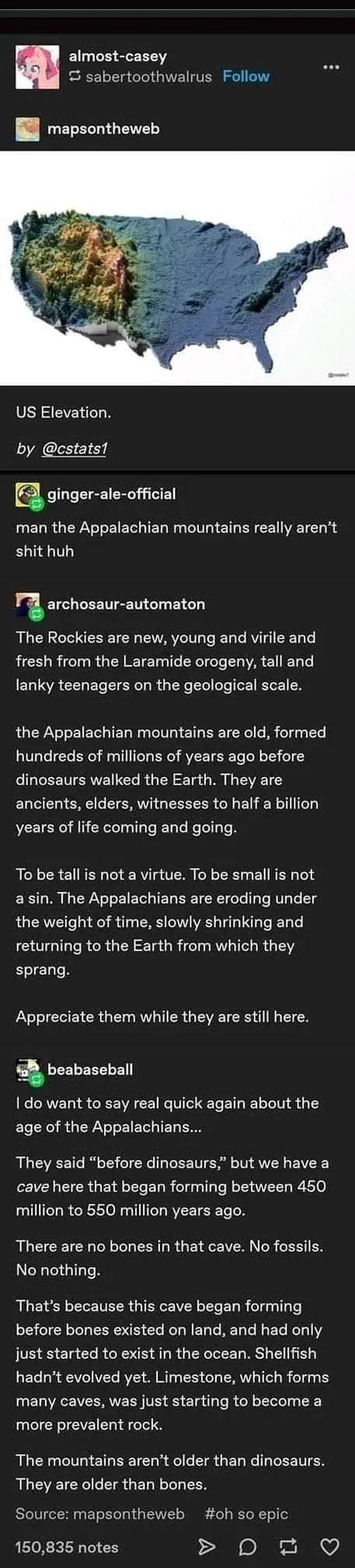
Small? The Appalachians today are the resting skeleton of a mountain range so tall and enduring that the mud and sand that washed off them piled miles high and formed the Catskill mountains. The Appalachians were so mighty that their garbage formed mountains

  • source
  • hideshow 10 child comments
  • [–] 50 points 2 years ago (2 children)

    Also they spread so far that they were broken when Pangaea, the first landmass, split apart. The other half is the Scottish Highlands. They are older than the Atlantic Ocean between them.

  • source
  • parent
  • hideshow 2 child comments
  • [–] 18 points 2 years ago

    One nit, pangea wasn't the first supercontinent, we know of at least two, maybe three before it. The stone of the Adirondak mountains was formed as part of the Grenville mountains, which were built by a suprecontinent 1.5 billion years ago (the adirondaks got tall be'ause of a much more recent, unrelated thing, but their stone is very old). The Grenville runs from Hudson Bay to Texas

  • source
  • parent
  • load more comments (4 replies)
    [–] 82 points 2 years ago (11 children)

    As a geologist who works in the Appalachians... They're cool af.

    Nothing is more surreal than being a geologist. Just today I was standing on a dirt road in the middle of farmers field. Looking at the ground is an innocuous little outcrop of boring looking rocks. But those rocks erupted at the bottom of a back arc basin off the coast of Laurentia, was buried by ocean sediment for ages, had an entire ISLAND of rock thrust onto it, and then buried 10s of kilometers deep. The history one rock can tell is amazing.

  • source
  • hideshow 11 child comments
  • [–] 19 points 2 years ago

    As a non-geologist living next to Lake Diefenbaker (the reservoir formed by damming the South Saskatchewan River), I also like geological history.

    I have a standard reply for when I'm asked why we chose to move to this "treeless wasteland". "I look out at the flat horizon and see how the glaciers planed the earth the way a woodworker flattens a board. I look around me at the river breaks and see how the meltwater from retreating glaciers carved the earth away into shapes that defy imagination." I don't know accurate any of that is, but it fits my mental model of what I was taught in high school.

    (What we call the river breaks are twisted and braided networks of coulees, some with sides so steep as to require mountaineering equipment. Most still run with meltwater in the spring.)

  • source
  • parent
  • [–] 11 points 2 years ago (8 children)

    I have started daydreaming of a career change to geology. There are just so many unanswered questions and its not like space or physics were these questions are tinyor super far away. You can just walk upto a geologic puzzle and hit it with a hammer.

  • source
  • parent
  • hideshow 8 child comments
  • [–] 7 points 2 years ago (3 children)
  • [–] 5 points 2 years ago* (2 children)

    Not sure if my username gave it away or not, but I’m really into applied mathematics. I’m a physics major right now, & while I don’t immediately see myself studying this in grad school, I think that the physics of Volcanism/Plate Tectonics is extremely fascinating. It certainly looks at the history of the world through a very different lens, but I wouldn’t write it off completely!! The physics of our Earth is a beautiful, beautiful thing. :)

  • source
  • parent
  • hideshow 2 child comments
  • load more comments (3 replies)
  • [–] 58 points 2 years ago* (9 children)

    At their highest it was estimated that the Appalachians were comparable to the Himalayas, with the potential for multiple Everest height mountains along the chain.

  • source
  • hideshow 9 child comments
  • [–] 33 points 2 years ago (2 children)

    They are also only half of the original mountain range, which was split when pangaea split apart.

    The other half is now resting across europe, I think along the northern range.

  • source
  • parent
  • hideshow 2 child comments
  • [–] 16 points 2 years ago (5 children)

    This is because thats basically the upper limit for how tall a mountain can be on this planet.

  • source
  • parent
  • hideshow 5 child comments
  • [–] 6 points 2 years ago (4 children)

    What's the limiting factor? I assume it's something with gravity?

  • source
  • parent
  • hideshow 4 child comments
  • [–] 7 points 2 years ago* (last edited 2 years ago) (1 child)

    I guess, because taller mountains need a bigger/heavier base (Mnt Everest is only a few km over it's base, stone is too brittle) and a too heavy base gets "liquid" on, or literally under the plate (it's magma underneath).

    Only guessing though.

    But then there's Himalaya and the whole mongolian ranges on the same plate...

    Seeing it like that, we are beings of energy, existing on the thin skin of a ball of molten stone, revolving around a ball of fire.

  • source
  • parent
  • hideshow 1 child comment
  • [–] 7 points 2 years ago

    Mountain bases can support a lot. Everest is not terribly tall from its base, true, but Denali is 5500 meters from base to top and Mauna Kea rises to 10000 meters over base.

    Its also a bit of an incorrect picure to think of the interior magma as a liquid. It can flow, but it can also sieze up or crack. Its an in-between, like corn starch and water.

  • source
  • parent
  • [–] 6 points 2 years ago

    Its indirectly gravity. The taller the mountain, the more eroding force can be pleced on it. Water travels faster and therefore cuts deeper.

    Everest is still uplifting fairly quickly at 1mm a year, but its also eroding at roughly the same pace and won't get significantly taller than it is now. The same is true for the rest of the Himalaya as well, the whole range is eroding at a very high pace.

    The Himalaya are home to some very spectacular canyons, including the largest canyon above water. The geology there is on full display and incredible.

  • source
  • parent
  • load more comments (1 reply)
  • [–] 53 points 2 years ago (5 children)

    Almost heaven, West Virginia

    Blue Ridge Mountains, Shenandoah River

    Life is old there, older than the trees

    Younger than the mountains, growin' like a breeze

  • source
  • hideshow 5 child comments
  • [–] 20 points 2 years ago (3 children)

    Never thought about the song that way...

    Wow.

  • source
  • parent
  • hideshow 3 child comments
  • [–] 12 points 2 years ago (2 children)

    LOVE this song, got it in a couple of lists. Never understood that lyric. Mr. Denver was ahead of us all.

  • source
  • parent
  • hideshow 2 child comments
  • load more comments (1 reply)
    [–] 36 points 2 years ago (5 children)

    And that is the scientific reason the Appalachians are haunted as hell.

  • source
  • hideshow 5 child comments
  • [–] 21 points 2 years ago (4 children)
  • [–] 5 points 2 years ago* (last edited 2 years ago) (2 children)

    As someone who reads much more than listens to podcasts, I've wanted to get into this series for years now, but it feels like I never have enough time, especially as I'm not sure my wife would be onboard with the idea of an audio serial.

    Then again, it is spooky season, so now's the time to pitch it, I guess. Any suggestions for diving in for a podcast novice who has a negligible commute and small kids at home? My kids are not sheltered but any stretch, but are probably too young for eldritch horror.

    Edit: really, it's the same issue I have with Critical Role; it sounds great to me, but finding enough time on my own to be able to get into it is way harder than reading a book.

  • source
  • parent
  • hideshow 2 child comments
  • load more comments (2 replies)
  • [–] 28 points 2 years ago* (1 child)

    I'm not really a science person, but that was super cool to read!

  • source
  • hideshow 1 child comment
  • [–] 22 points 2 years ago

    And by "enjoy them while you can" it really means "your life will elapse millions of times over before they're gone"

  • source
  • [–] 10 points 2 years ago

    I had to look if this was posted in Science Memes or RPG Memes.

  • source
  • [–] 10 points 2 years ago (3 children)

    One thing that will never seem to leave my head is that I had read that the current mountain tops of the Appalachians are actually the original valleys of the mountain range. The mountains were so old and large that the valleys of todays Appalachian’s were the footprint of what was once maybe the largest mountain range earth has seen

  • source
  • hideshow 3 child comments
  • [–] 9 points 2 years ago

    What we see now are the ancient roots. Before the continental colision, there was a sea and subduction zone. This gave us sandstones, diorite, and granite... All of which were crushed at incredible pressure and temperature by the continental collision. At the deep roots of the mountains, this transformed the rock into gneiss, marble, and other extremely hard rock. Additionally, the forces were so great that the very bottom melted and became fresh granite.

    All of these stones are very hard and resistant to erosion, and are what we see todayas the Appalachians

  • source
  • parent
  • [–] 9 points 2 years ago

    I love the amount of praise in these comments. My dad is a geologist and used to always gush about the Appalachians when I was growing up

  • source
  • [–] 7 points 2 years ago (1 child)
  • load more comments
    view more: next ›