all 47 comments

sorted by: hot top controversial new old
[–] 83 points 11 months ago (7 children)

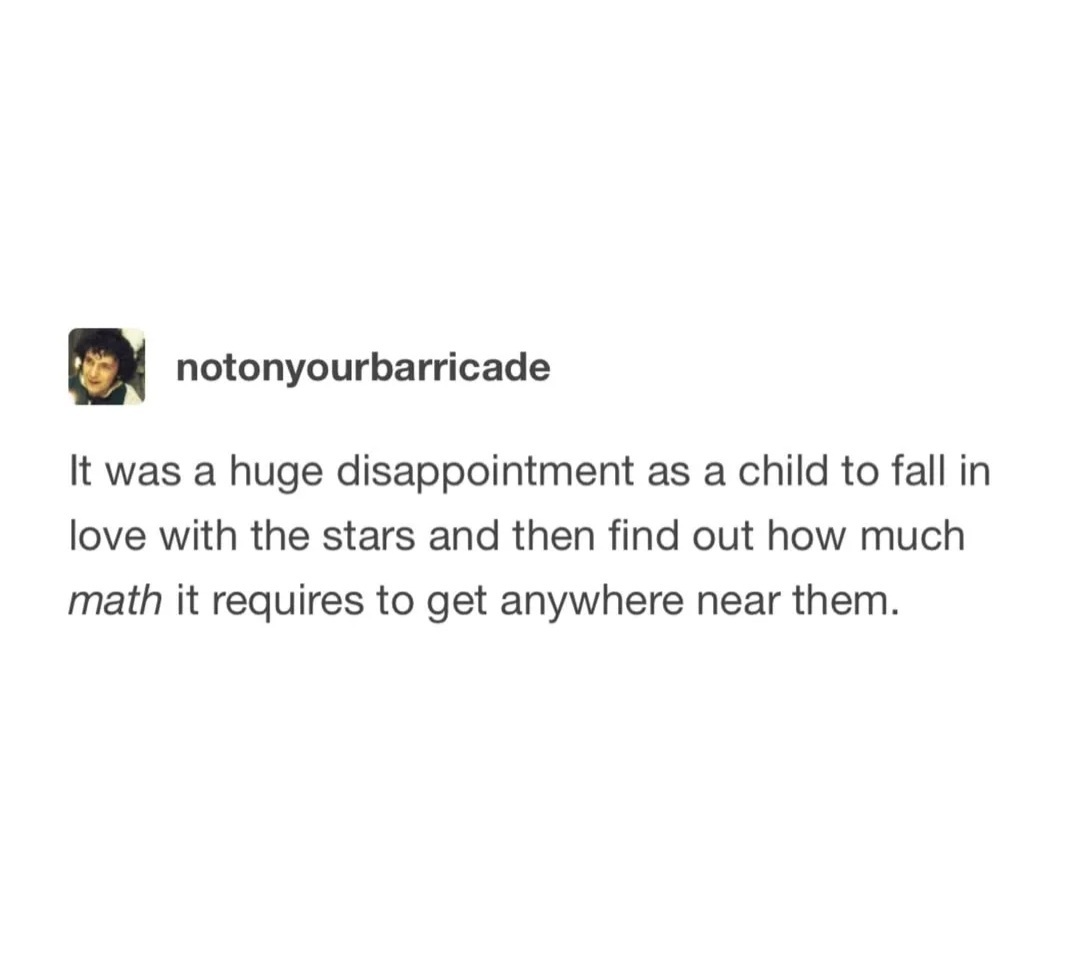
The math isn't really the main limiting factor to getting close to stars.

  • source
  • hideshow 7 child comments
  • [–] 2 points 11 months ago (3 children)

    but you need to have significant math skills to even understand physics in general.

  • source
  • parent
  • hideshow 3 child comments
  • [–] 42 points 11 months ago (5 children)

    That or the right job application and a lot of propellant and oxidizer - but seriously, don't do that. It didn't end well for Icarus. Gravitationally-driven open-core fusion reactors are best admired from a safe minimum distance.

  • source
  • hideshow 5 child comments
  • [–] 20 points 11 months ago (2 children)

    lot of propellant and oxidizer

    You can only realistically get close to one of them that way.

    You are better off studying plasma containment fusion. And that's a fuckton of math.

  • source
  • parent
  • hideshow 2 child comments
  • [–] 13 points 11 months ago

    Oh no. You can get close to any star of your choosing with only minuscule amounts of reaction mass if you start out in vacuum away from significant gravity wells - eventually. Granted, the star in question may or may not have gone supernova or collapsed into a black hole by the time you arrive, but I doubt that'll make a lot of difference to the person doing it at that point.

    With that said, I'm not about to discourage anybody from taking an interest in fusion of the up-close-and-personal-kind. And if people aren't into the math of Magnetohydrodynamics? Well, first off, sucks to be them, but second: Then donate to the cause to pay those who are. Fusion is fucking awesome, and we desperately need it.

  • source
  • parent
  • [–] 2 points 11 months ago

    Even fusion constrains you to the limits of the rocket equation. Laser sails on the other hand, could let you put the bulk of your propulsion system in orbit of the sun or something where you don't have to carry it with you.

  • source
  • parent
  • [–] 15 points 11 months ago (1 child)

    If you learn just a little bit of math you can realize that no one else is getting anywhere near them either.

  • source
  • hideshow 1 child comment
  • [–] 16 points 11 months ago* (last edited 11 months ago)

    Next year, Voyager I will have traveled 1 light day. It will also be over 49 years old at that time. Think about that for a moment. Almost 50 years to travel the time it takes light to travel in a single day. Our closest star is Proxima Centauri at 4.25 light years away. To reach Proxima Centauri, Voyager I would need to travel ~77,500 years. Voyager 1 is one of the fastest man-made objects in existence and it would take far longer than the entire history of civilization to arrive.

    Space is big.

  • source
  • parent
  • [–] 11 points 11 months ago

    Eh, I remember just googling space stuff and absorbing info and that alone had enough dopamine. My world was so small before I got access to the internet, when I was a kid, I had a children's book about science stuff, stars, but they barely had much info. Internet access was so magical. Unlimited information.

  • source
  • [–] 10 points 11 months ago (1 child)

    Nah, just take a positional average and you're pretty much in the middle of one!

  • source
  • hideshow 1 child comment
  • [+] 7 points 11 months ago* (last edited 7 months ago) (2 children)
  • [–] 6 points 11 months ago

    Artists can get intimately acquainted with them anytime.

  • source
  • [–] 6 points 11 months ago (2 children)

    I thought they meant movie stars and meant you could only get near them by becoming an engineer. I'm... not that smart at certain hours of the day.

  • source
  • hideshow 2 child comments
  • [–] 6 points 11 months ago

    I kept reading stairs but yeah both I guess

  • source
  • [–] 5 points 11 months ago

    I interpreted this to mean that you need to learn a lot of math in order to have a career in astronomy. I don't think OP thought it was possible to actually go to the star and math was the limiting factor.

  • source
  • [–] 5 points 11 months ago

    Easier to reach the stars with meth, not math.

  • source
  • [–] 4 points 11 months ago

    Same thing with video games

  • source
  • [–] 4 points 11 months ago* (1 child)

    This requires lots of Physics. The math required is relatively minimal.

  • source
  • hideshow 1 child comment
  • [–] 3 points 11 months ago

    Just define "star" to include Earth, then you're already very close to one!

  • source
  • [–] 3 points 11 months ago (1 child)

    reading that as "stairs" was hella confusing for a solid minute.

  • source
  • hideshow 1 child comment
  • [–] 1 point 11 months ago

    yes, astronomy, astrophysics, if yuo dont have knack in that field you wont get into it. physics, if you cant pass simple CComunity level physics classes(for scientists, not for life sciences), you wont pass upper division physics.

  • source
  • [–] 1 point 10 months ago

    🤭I did read meth

  • source
  • [–] 0 points 11 months ago (9 children)

    That’s because math is fundamentally flawed.

    Shhhhh. Don’t tell anyone, they get all upset about it.

  • source
  • hideshow 9 child comments
  • [–] 4 points 11 months ago (8 children)

    Interesting! Could you elaborate on this? I'm intrigued to know the intrinsic flaws.

  • source
  • parent
  • hideshow 8 child comments
  • [–] 1 point 11 months ago (2 children)

    It has to do with creating measuring devices out of what we can empirically derive, and building successive generations off of those. It’s fine for our local system but by the time you get intergalactic (or quantum) with it, flaws start to propagate themselves bigly.

    I can’t reveal more at this time or Big Math will get suspicious.

  • source
  • parent
  • hideshow 2 child comments
  • [–] 1 point 11 months ago* (last edited 11 months ago) (4 children)

    Kurt Gödel wrote a whole paper on it.

    He used math to show that all statements, in any language, can be expressed as math statements. He then proved that it's impossible to create any consistent set of math statements that completely describes everything.

  • source
  • parent
  • hideshow 4 child comments
  • [–] 5 points 11 months ago

    That doesn’t make it fundamentally flawed. I also can’t completely describe all muscle movement involved and yet I can walk.

    Gödel’s incompleteness theorem has to be the most overhyped thing since a certain cat. For logicians, it mainly means that “is it probable” is a valid question for prepositions that are otherwise vastly esoteric in nature.

  • source
  • parent
  • [–] 1 point 11 months ago* (last edited 11 months ago)

    That's not a flaw. It's one of the greatest mathematical revelations of the 20th century.

    It's only a "flaw" for people who want to believe in some imaginary positivism. This is a popular grift under capitalism. See also the entire field of economics.

  • source
  • parent
  • [+] 0 points 11 months ago* (last edited 11 months ago) (1 child)
  • [–] 0 points 11 months ago* (last edited 11 months ago)

    euclidean geometry is famously complete

    Nah, euclidean geometry was not complete. Tarski didn't come up with a complete version until the 20th century. I'm not sure how famous Tarski geometry is, but it doesn't seem very famous in USA outside of math depts.

    this doesn’t mean that “it’s impossible to create any consistent set of math statements that completely describes everything,”

    It says far less than that: "It’s impossible for a mathematical system containing the natural numbers to be both complete and consistent."

    In itself it has very little to do with physical reality. I think it's more about how we think about math and then its applications.

    reality itself could be a complete system, understandable from both the outside and inside if only viewed at the right angle…

    This has been largely debunked.

    hilbert’s dream is not dead yet,

    I dunno what his dream was, but Hilbert's program is very much dead.

  • source
  • parent