all 27 comments

sorted by: hot top controversial new old
[–] 60 points 2 years ago (1 child)

Meanwhile, in English:

Yoo-hoo! Thereau thoroughly thought ‘twas you, Hugh, who threw Theaux through the tough dough trough.

Thou laughed, though! No? He ought not’ve thought aught of it.

  • source
  • hideshow 1 child comment
  • [–] 25 points 2 years ago* (2 children)
  • [–] 16 points 2 years ago (8 children)

    It it a homonym? Or is this due to their different scripts?

  • source
  • hideshow 8 child comments
  • [–] 41 points 2 years ago (3 children)

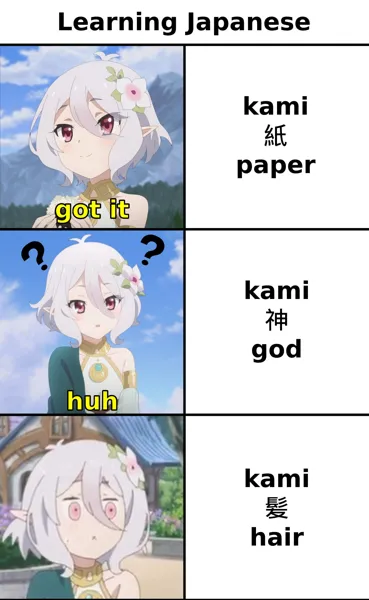
    These are homophones in Japanese. Same thing as words like their/there/they're or seas/sees/seize, etc. Words that sound the same but are written differently. The Japanese language has tons of them. Often, the ambiguity around homophones is used as a source of humor, causing misunderstandings between characters in anime/manga or puns that add a layer of humor to an otherwise normal thing to say.

  • source
  • parent
  • hideshow 3 child comments
  • [–] 6 points 2 years ago

    Both kinda, they have different scripts because they have so many homophones. Japanese has far fewer phonemes (possible sounds) compared to english, this combined with the fact that you usually can't have two consonants together without a vowel in between makes it so the amount of possible words is very limited. Because of this if you used just the "phonetic" script hiragana ( each character represents a sound) then it would get confusing since かみ that represents the sound "kami" would be confusing as to what you're referring to. So they mix in kanji, Chinese characters where a character represents a thing, to distinguish these homophones.

  • source
  • parent
  • [–] 5 points 2 years ago (2 children)

    Complete guess, but probably because these are Chinese characters (kanji), which is more phonetic.

  • source
  • parent
  • hideshow 2 child comments
  • [–] 3 points 2 years ago (1 child)

    Maybe a tonal difference as well?

  • source
  • parent
  • hideshow 1 child comment
  • [–] 8 points 2 years ago

    Not tonal, but pitch accent difference. The first and last words (紙 and 髪) are indistinguishable by pronunciation, both are flat (pitch accent 平板 or 'flat'). For the second word (神), the pitch accent descends for み (pitch accent 頭高 or 'head high').

  • source
  • parent
  • [–] 15 points 2 years ago

    You forgot about 噛み (to bite)

  • source
  • [–] 13 points 2 years ago (2 children)

    kami kami kami -> Paper hair God

  • source
  • hideshow 2 child comments
  • [–] 9 points 2 years ago (2 children)

    My favourite is still: 庭には二羽鶏がいる Niwa niwa niwa niwatori ga iru There are two chicken in the garden.

  • source
  • hideshow 2 child comments
  • [–] 8 points 2 years ago* (last edited 2 years ago)

    My favorite has to be 切る. 26 ducking meanings! It's not even a different kanji per meaning! WTF!

    Also mandatory Dogen video.

  • source
  • [–] 8 points 2 years ago* (last edited 2 years ago) (2 children)

    Japanese has significantly fewer sounds than many languages, so homonyms are inevitable. Thanks to kanji this isn't much of an issue in written Japanese, but spoken Japanese (and Japanese written without the use of kanji) relies heavily on context.

    The alternative would be ridiculously long words. Example: the English word "extra" (five letters, two syllables) is pronounced "ekisutora" in Japanese (still five letters, but also five syllables); this is a result of every consonant needing to be followed by a vowel (except for "n" and a short list of compounds like "sh"). Additionally, Japanese only has five vowel sounds, plus a few that you can force out (e.g. "ka" can be slightly modified to "kya" to approximate the "a" sound in "cat"). Japanese also contains fewer consonant sounds than a number of other languages.

  • source
  • hideshow 2 child comments
  • [–] 6 points 2 years ago (1 child)

    I find fun to learn Japanese. It's the fourth language I study, and so far it's been both different and intuitive, but I fear the moment where I need to go deeper into kanji, given the limitations you mention.

    It's also a slower process than learning any major language, as it took us a few weeks to get to review their letters. Its been fulfilling so far, but I don't know how invested one can be once you reach a certain point of increased complexity.

  • source
  • parent
  • hideshow 1 child comment
  • [+] -1 points 2 years ago* (last edited 2 years ago) (1 child)