360
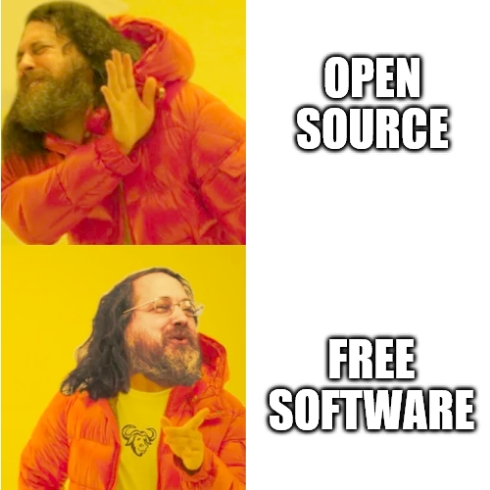
IMO both of these ended up being poor names.
"Open source" can be co-opted to mean any project with public source code even if it's not open contribution (think SQLite, and many of the projects effectively run by major tech corporations).
"Free software" falls victim to the eternal mixup with freeware, requiring the endless repetition of the "beer vs. speech" analogy.
I personally think "Libre software" is the term that best encapsulates the intended meaning while being unambiguous and not vulnerable to misinterpretation.
It's FOSS not clear enough?
FLOSS
More people need to hear that either way
FOSS is even worse. Free and Open Source makes it sound like free of charge and see my source code.
It's also a politically neutered term and an acronym of conflated concepts.
FOSS is... Literally as you described it.
What is there to conflate? It's pretty obvious.
FOSS attempts to conflate two different positions on software by presenting them as one entity. FLOSS is a better term for pure neutrality's sake but still falls in the same trap (attempting to send meaning as acronym/conjoining two historically different movements). Free software advocates do not bother with a neutral term because we desire a world of total software liberation and an ultimate death to non-free software. Open-source movements seek to collaborate with proprietary software or at the very least not to get in its way (it seeks olive branches over systemic change). Each group's rhetoric serves to reflect this fundamental difference. There is an overlap in both movements, but each person has to choose between compliance to the status quo or fighting to break it altogether.
Look at it this way, hypothetically, if it turned out that the Linux kernel was objectively the technically superior computer kernel to have ever existed and will ever exist and everyone in the entire world knew this: we would still end up in the same exact status quo because corporate oligarchs are already allowed to use the kernel to subjugate their users (nonfree firmware, tivoization/weak copyleft, proprietary userland) and have enough leftover propaganda (what they call marketing) and staying power to ensure their survival. Or in other words: if Linus Torvalds, the man who figuratively holds the keys to the most successful open source project in the world (that powers the entire internet) is still subjugated by firmware blobs and nonfree drivers, what chance do we have with these unethical firms?
FOSS is… Literally as you described it ... It’s pretty obvious.
Please don't reduce decades of uncomfortable and complex history to what is a marketable buzzword. I doubt we disagree all too much here, but the goal is to educate, not condense and dilute.
"Freedom-respecting software" is another less ambiguous term.
That would be a better description indeed.
English language...
Many other languages have different words for each type of free
And yet our professors at university translated "free software" using our word meaning "free of charge", my ears bled. It should have been libre software from the beginning.
What sucks more was my CS teacher translating term "Open source" as free of cost lol. How the fuck
It's called LIBRE software.
Because its not free as in free beer.
It works better in other languages.
e.g. Es ist frei, nicht kostenlos.
Freibier ist aber kostenloses Bier.
Every time I see this phrase it makes me wonder, if the libre software grants the user a right to redistribute itself wouldn't that imply that it is both free as in speech and as in beer?
I mean, it may be sold, sure, but it would work more like donation, since you also can get a copy from another user instead.
I don't often hear it called libre software, but I like it. Better than open source or free software. I'm glad this kind of discussion is back again. It's more important than ever with the increasingly clear unfolding corporate takeover of the Internet.
I am more of a Libre type of guy
Lets not forget: Linus Torvalds and the Linux Foundation's policies don't actually believe in software freedom. The refusal to upgrade to GPLv3 has directly impacted those who use ChromeOS, Android, and WSL; as well as appliances that use GNU/Linux.
They do not believe in liberation.
(Inb4 someone parrots the "pragmatism" fallacy and proves my point again)
Linus Torvalds and Richard Stallman never agreed one another. Their principles are very different, Torvalds is more like a tech boy that is inclined to business in other hand we have Stallman that is more a tech philosopher. I am with Stallman. But both are very important for FOSS community. I equally respect both.
I also respect both I agree (no GNU/Linux user would deny that), but Torvalds has faced little to no mainstream criticism on his hypocritical stance. Take one look at the Linux Foundation's top board members and see if they represent the Freeworld. Torvalds directly benefits from a lack of political ethos on Free software.
Stallman asks for the name GNU/Linux to be used and gets bullied online (to this day) by ignorant users who refuse to learn the history. Torvalds directly enables the subjugation of others via tivoization and weak copyleft? The "FOSS community" is near silent in comparison. All in the name of pragmatism that has left so many users uneducated and confused.
When Stallman tells us to say "Free software" he does not mean to say "free for me but not for thee (because I have to feed my rhetorical family in this fast-paced economy)." He seeks total liberation.
Your comment is very accurate I agree 100% with you man.
I also agree with him even though I didn't understand a thing. What is FOSS?
Free Open Source Software, iirc
Join us now and share the software
You will be free hackers, you will be free
NGL, the text order is backwards and it's kinda bothering me.
Redhat wants to know your location.
Hint: :q!
Sister communities:
Community rules (click to expand)
1. Follow the site-wide rules
sudo in Windows.Please report posts and comments that break these rules!
Important: never execute code or follow advice that you don't understand or can't verify, especially here. The word of the day is credibility. This is a meme community -- even the most helpful comments might just be shitposts that can damage your system. Be aware, be smart, don't remove France.