I'm lucky my banking app works (GrapheneOS), as it's now requiring 2FA with the app anytime I login on the browser. Can't use an actually secure form like TOTP. At least they now allow passwords over 8 characters (yes, serious).
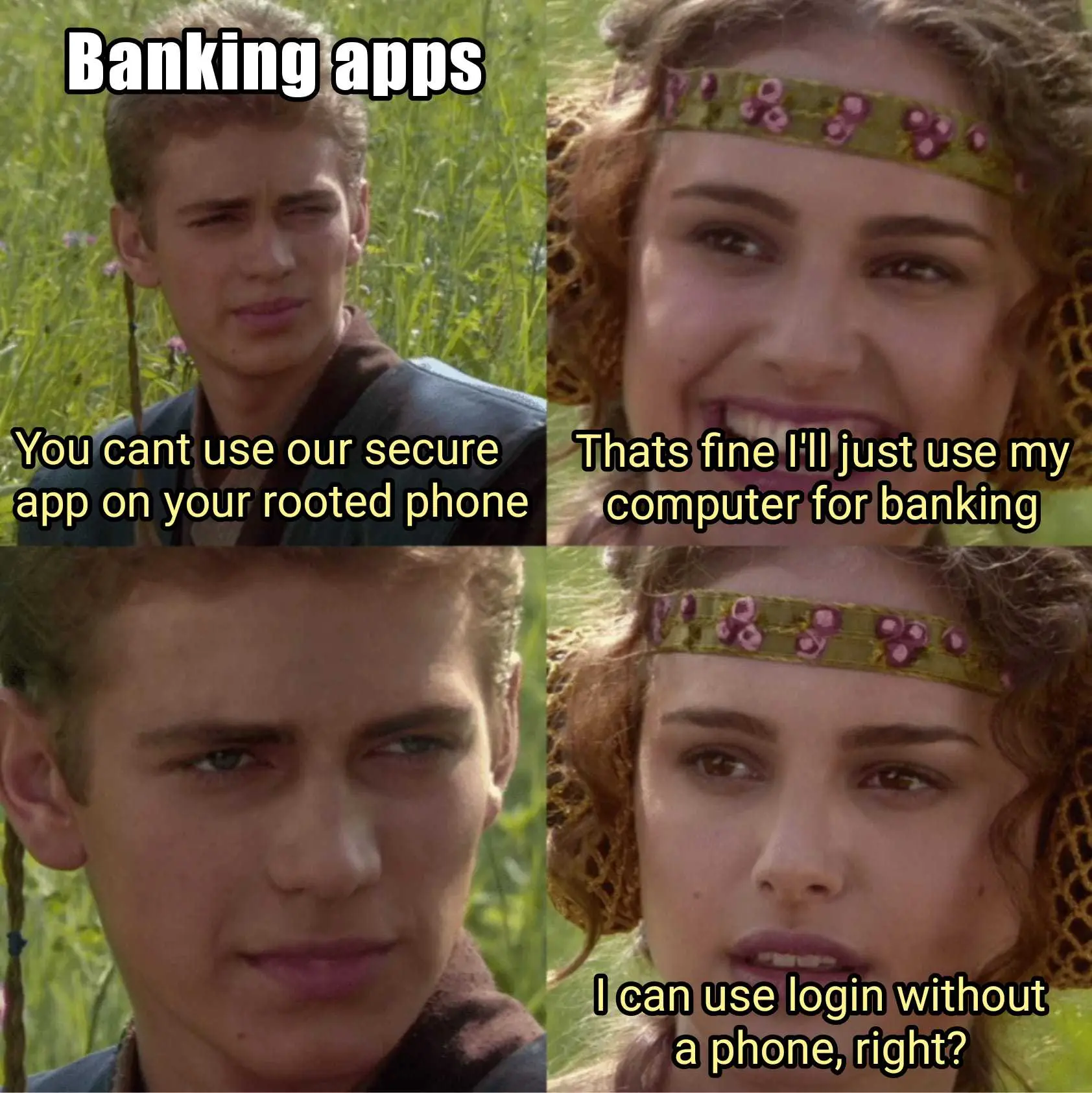
(Meme in comments)
I'm lucky my banking app works (GrapheneOS), as it's now requiring 2FA with the app anytime I login on the browser. Can't use an actually secure form like TOTP. At least they now allow passwords over 8 characters (yes, serious).
(Meme in comments)
If you have the UI layer able to grant root access, it has root access itself and is not sandboxed. If the UI layer can grant it, an attacker gaining slight control over it has root access. An accessibility service trivially has root access. A keyboard can probably get root access, and so on. Instead of a tiny little portion of the OS having root access, a massive portion of it does.
In the verified boot threat model, an attacker controls persistent state. If you have persistent root access as a possibility then verified boot doesn't work since persistent state is entirely trusted.
A userdebug build of AOSP or GrapheneOS has a su binary and an adb root command providing root access via the Android Debug Bridge via physical access using USB. This does still significantly reduce security, particularly since ADB has a network mode that can be enabled. Most of the security model is still intact. This is not what people are referring to when they talk about rooting on Android, they are referring to granting root access to apps via the UI not using it via a shell.