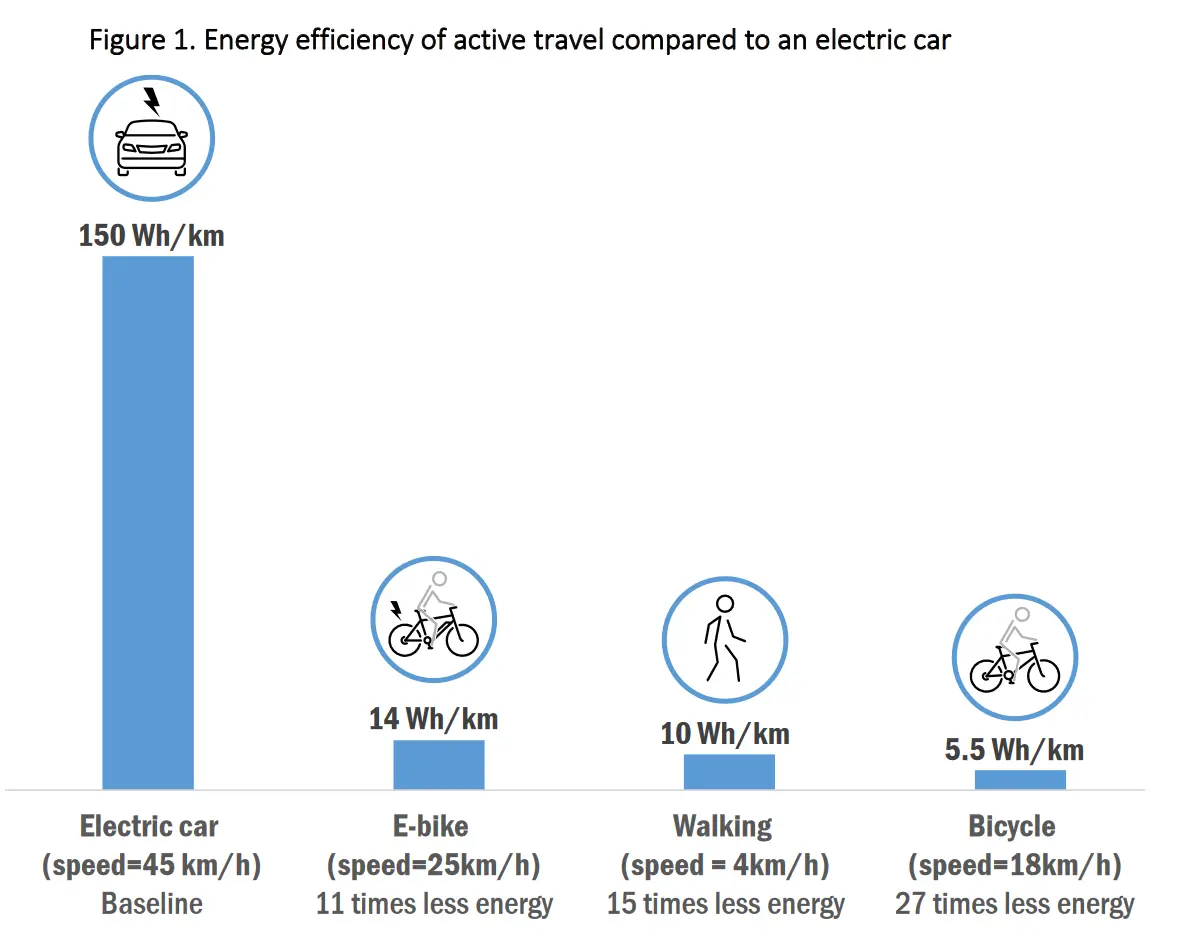
I think many people peddle just as hard on an electric bike, so the 5.5 kWh/km is a given, the rest is the energy required to go faster. Since air resistance increases with the square of the speed, it might very well be the case that 14 kWh/km at 25 km/h is more efficient than what the human alone would need to deliver for the same speed.
Edit: I failed to take into account that for the human at the same level of effort the power remains constant, not the energy per kilometer. Going faster at the same power output would reduce the energy expenditure per kilometer for the human to about 4 kWh/km, which would indicate that 10 kWh/km is being delivered by the motor to go faster.
That being said, it might be the case that they just calculated the energy needed to move the bicycle without taking the energy efficiency of the digestive system into account.