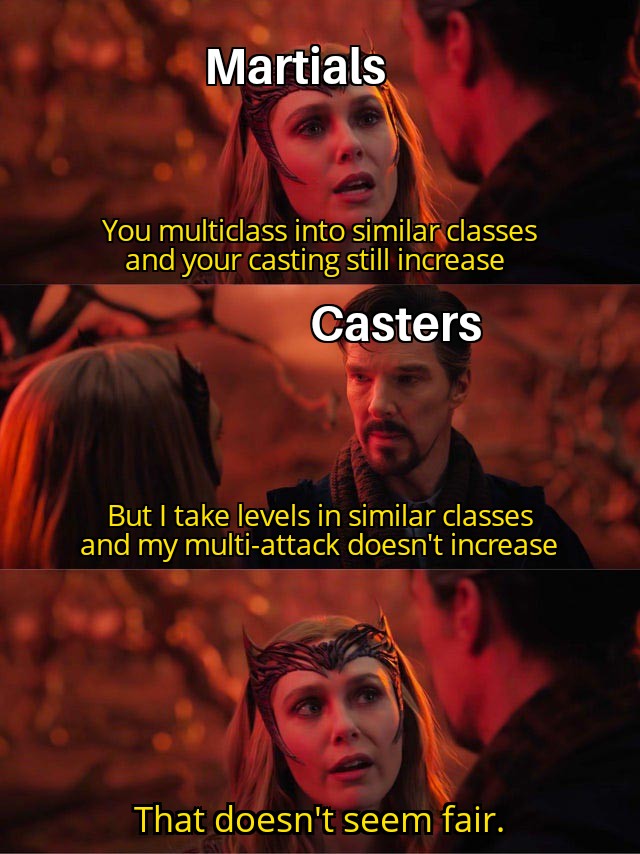
Martials don't even get anything from a 5th level multiclass into another martial class
(ttrpg.network)
What portion of the
do you list for every character on your GM screen? Are you running games with 6+ players? And what other value does that provide? Do you also account for possible bonuses, some of which can be activated as reactions? Do you update it when values change mid-session (like if a player changes shape, enters or leaves a paladin’s aura, or attunes-deattunes an item that boosts a stat)? Because if so, that sounds like a lot of bookkeeping for very little value to me, and if not, then there’s even less value. If it’s baked into your VTT then sure, but I don’t think most groups playing in person use a VTT at the table.
What are you listing on your main screen? I’d think that all of these things would be more important than duplicating the info PCs themselves have: having a copy of the map (with everything visible or with LOS / fog of war / lighting applied to the selected PC/NPC/monster), initiative (which could be swapped out for 1-2 PC stats outside of combat), players’ passive values, everyone’s HP + status effects, notes on NPC and monster motivations, reminders (e.g., tell the Fighter they find a note from an NPC in their backpack when they say they’re getting something or during downtime), notes related to what you actually have planned for the session, etc..
Noticing that the Rogue has been doing very well on thieves tools checks and thus not making them roll to pick a lock is a clear example of the possible ways DM bias can occur, since another character (let’s say a Wizard with History expertise) with a skill bonus that’s just as high that hasn’t come up as much won’t get that same benefit. On the other hand, if you don’t have auto crit fails on 1s, then you can just let the Rogue succeed without treating the Wizard unfairly - yes, they have to roll, but there’s no chance of them failing that the Rogue doesn’t have.
That all said, if you have auto crit fails on 1s, why are you not asking for rolls all the time, anyway? Seems inconsistent, as not asking for a roll from someone who will succeed on a 1 is the same (in terms of possible outcomes) as allowing a roll but waiving the chance of an automatic failure on a nat 1. Why not just get rid of that chance in all cases?