It's getting more and more unhinged on LinkedIn.
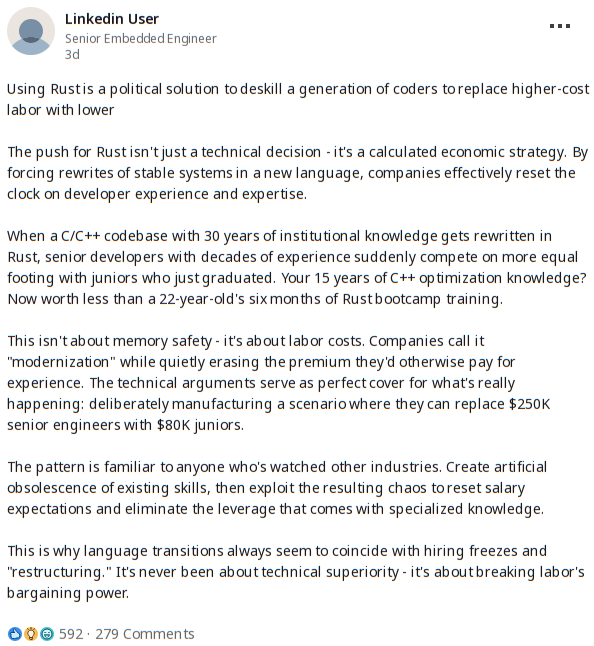
A linkedin post by a Senior Embedded Engineer stating: Using Rust is a political solution to deskill a generation of coders to replace higher-cost labor with lower  The push for Rust isn't just a technical decision - it's a calculated economic strategy. By forcing rewrites of stable systems in a new language, companies effectively reset the clock on developer experience and expertise.  When a C/C++ codebase with 30 years of institutional knowledge gets rewritten in Rust, senior developers with decades of experience suddenly compete on more equal footing with juniors who just graduated. Your 15 years of C++ optimization knowledge? Now worth less than a 22-year-old's six months of Rust bootcamp training.  This isn't about memory safety - it's about labor costs. Companies call it "modernization" while quietly erasing the premium they'd otherwise pay for experience. The technical arguments serve as perfect cover for what's really happening: deliberately manufacturing a scenario where they can replace $250K senior engineers with $80K juniors.  The pattern is familiar to anyone who's watched other industries. Create artificial obsolescence of existing skills, then exploit the resulting chaos to reset salary expectations and eliminate the leverage that comes with specialized knowledge.  This is why language transitions always seem to coincide with hiring freezes and "restructuring." It's never been about technical superiority - it's about breaking labor's bargaining power.
you are viewing a single comment's thread
view the rest of the comments
[–] 8 points 2 years ago (2 children)

The only reason most of these places that do that though, is because they wrote in COBOL to begin with decades ago, and didn’t want to switch away to something more modern as other languages gained functionality and popularity.

And it would've been much cheaper to rewrite once some years ago than to keep paying people to maintain it.

And in many cases, rewriting something improves the code substantially by finding bugs and fixing architectural issues. Old code doesn't mean it's correct, it's just old, and just today we had a high severity bug from code that was never properly tested and sat unchanged since near the start of the project.

  • source
  • parent
  • hideshow 2 child comments
  • [–] 1 point 2 years ago (1 child)

    I think that many a time people begin a project coding in a far-far-far too-low level programming-language: they're solving the wrong problem!

    Build your prototype in a high level language, get the model/architecture correct .. and THEN begin replacing the slow bits with faster languages..

    To me that seems right.

    Haskell to begin-with, & when it solves ALL of the problem, correctly .. THEN you begin converting stuff to Crab-lang/Rust..

    When you're still bashing 'round, trying to discover the form of the underlying problems in your problem .. that's the wrong time to be doing low-level stuff, to my eyes..

    _ /\ _

  • source
  • parent
  • hideshow 1 child comment
  • I get the sentiment, but I think Rust does a pretty decent job even in the prototyping phase. I'll run snippets in Python or Lua, but that's mostly for data mangling, like generating code from a data format or preparing test data.

    So far it works pretty well.

  • source
  • parent