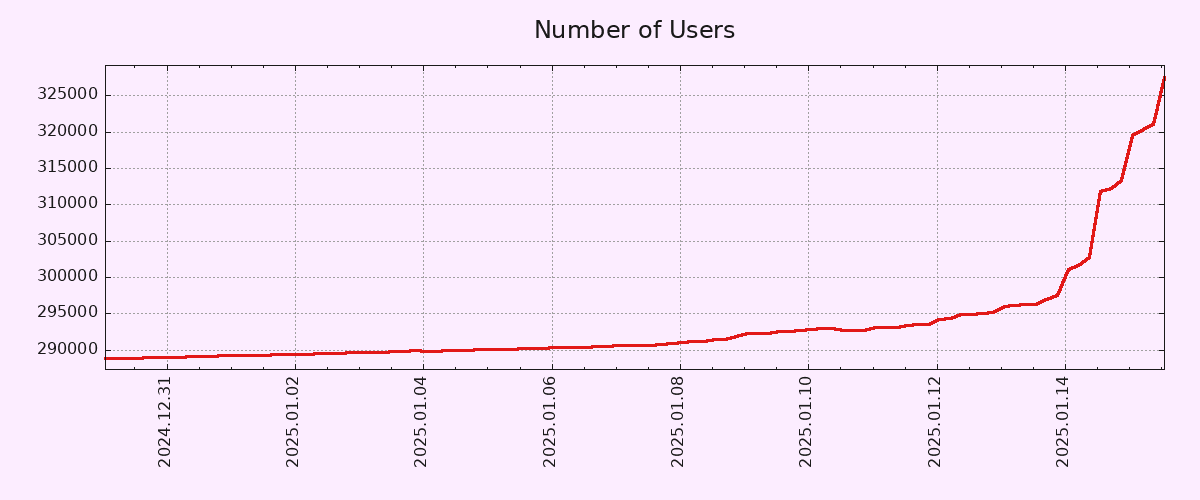
▲ 766 ▼ Pixelfed user count has gone vertical. (lemmy.world) submitted 2 years ago* (last edited 2 years ago) by korendian@lemmy.world to c/fediverse@lemmy.world 184 comments fedilink hide all child comments Editing to let people know that I will be blocking anyone who feels the need to tell me why this graph is inaccurate. I truly don't care, but feel free to chime in with your useless take and land a spot on my block list! 🙂
[–] porous_grey_matter@lemmy.ml 14 points 2 years ago (8 children) Lemmy was at 15k MAU, went up to over 125k and now is 1/3 of that. So it increased by 200% permalink fedilink source parent hideshow 8 child comments replies: [+] rglullis@communick.news -13 points 2 years ago (7 children) Oh, wow, very impressive! Did you have to use a calculator to get to this challenging result? Communick's revenue grew 1800% in 2024, compared to 2023. Do you think that makes it successful in any way? permalink fedilink source parent hideshow 7 child comments replies: [–] Blaze@feddit.org 11 points 2 years ago Oh, wow, very impressive! Did you have to use a calculator to get to this challenging result? That's unnecessarily agressive permalink fedilink source parent [–] porous_grey_matter@lemmy.ml 9 points 2 years ago (5 children) Successful or not, it isn't back to baseline permalink fedilink source parent hideshow 5 child comments replies: [–] rglullis@communick.news -5 points 2 years ago (4 children) Again: "back to baseline" is not meant in absolute numbers, but trend-wise. permalink fedilink source parent hideshow 4 child comments replies: [–] porous_grey_matter@lemmy.ml 8 points 2 years ago (3 children) It's not "again" for anything you've written in this comment thread. And you specifically suggested that these numbers can't be extrapolated, i.e. that they are not a trend. If it's indeed a trend for Lemmy to have 200% yoy growth then yeah, I'd think that'd be pretty successful. permalink fedilink source parent hideshow 3 child comments replies: [–] rglullis@communick.news -3 points 2 years ago* (2 children) It’s not “again” for anything you’ve written in this comment thread. Try the sibling: https://communick.news/comment/4203442 If it’s indeed a trend for Lemmy to have 200% yoy growth then yeah, I’d think that’d be pretty successful. You got it exactly backwards. There is a decline trend (monthly users go down month after after a spike) while the "200% growth" is not determined by any curve and can not be measured by any specific interval, because it was driven by one stochastic event that brought 100k people out of a sudden (the Reddit migration) To go back to my original comment: let's see how the numbers are going to be in the next month. If the first derivative is still positive, then we can talk about "trends", until then we are just senseless cheering and extrapolating out of one data point. permalink fedilink source parent hideshow 2 child comments replies: [–] Aceticon@lemmy.dbzer0.com 3 points 2 years ago* (last edited 2 years ago) (1 child) The expression "back to baseline" comes from Science and Engineering and literally means that something has gone back to the previous average flat level (for example: "the power line noise level spiked when your turned the machine on but is now back to baseline") Edit: not average, but actually specifically the original flat level below which things would not fall. Sorry, it's kinda hard to explain in words but very easy to point out in a graph or a scope were it's just this flat line to which things always return. That expression makes sense if you're talking about the rate of growth itself (i.e. the Lemmy rate of growth spiked at the time of the Reddit changes and eventually went back to baseline, since Lemmy is not growing any faster now than before the Reddit changes) but it doesn't make sense if you're talking about user numbers since the number of Lemmy users grew a lot with the Reddit changes and never went back to the average before them, not even close. Your original post is not clear on which of those things you're talking about when you wrote "back to baseline" and your subsequent posts are mainly talking about user numbers, giving the idea that that's what your "back to baseline" is refering to, in which case you're using that expression incorrectly. permalink fedilink source parent hideshow 1 child comment replies: [–] rglullis@communick.news 1 point 2 years ago Yeah, my bad. But the emphasis should be on "slide back", i.e, the derivative is negative. permalink fedilink source parent
[+] rglullis@communick.news -13 points 2 years ago (7 children) Oh, wow, very impressive! Did you have to use a calculator to get to this challenging result? Communick's revenue grew 1800% in 2024, compared to 2023. Do you think that makes it successful in any way? permalink fedilink source parent hideshow 7 child comments replies: [–] Blaze@feddit.org 11 points 2 years ago Oh, wow, very impressive! Did you have to use a calculator to get to this challenging result? That's unnecessarily agressive permalink fedilink source parent [–] porous_grey_matter@lemmy.ml 9 points 2 years ago (5 children) Successful or not, it isn't back to baseline permalink fedilink source parent hideshow 5 child comments replies: [–] rglullis@communick.news -5 points 2 years ago (4 children) Again: "back to baseline" is not meant in absolute numbers, but trend-wise. permalink fedilink source parent hideshow 4 child comments replies: [–] porous_grey_matter@lemmy.ml 8 points 2 years ago (3 children) It's not "again" for anything you've written in this comment thread. And you specifically suggested that these numbers can't be extrapolated, i.e. that they are not a trend. If it's indeed a trend for Lemmy to have 200% yoy growth then yeah, I'd think that'd be pretty successful. permalink fedilink source parent hideshow 3 child comments replies: [–] rglullis@communick.news -3 points 2 years ago* (2 children) It’s not “again” for anything you’ve written in this comment thread. Try the sibling: https://communick.news/comment/4203442 If it’s indeed a trend for Lemmy to have 200% yoy growth then yeah, I’d think that’d be pretty successful. You got it exactly backwards. There is a decline trend (monthly users go down month after after a spike) while the "200% growth" is not determined by any curve and can not be measured by any specific interval, because it was driven by one stochastic event that brought 100k people out of a sudden (the Reddit migration) To go back to my original comment: let's see how the numbers are going to be in the next month. If the first derivative is still positive, then we can talk about "trends", until then we are just senseless cheering and extrapolating out of one data point. permalink fedilink source parent hideshow 2 child comments replies: [–] Aceticon@lemmy.dbzer0.com 3 points 2 years ago* (last edited 2 years ago) (1 child) The expression "back to baseline" comes from Science and Engineering and literally means that something has gone back to the previous average flat level (for example: "the power line noise level spiked when your turned the machine on but is now back to baseline") Edit: not average, but actually specifically the original flat level below which things would not fall. Sorry, it's kinda hard to explain in words but very easy to point out in a graph or a scope were it's just this flat line to which things always return. That expression makes sense if you're talking about the rate of growth itself (i.e. the Lemmy rate of growth spiked at the time of the Reddit changes and eventually went back to baseline, since Lemmy is not growing any faster now than before the Reddit changes) but it doesn't make sense if you're talking about user numbers since the number of Lemmy users grew a lot with the Reddit changes and never went back to the average before them, not even close. Your original post is not clear on which of those things you're talking about when you wrote "back to baseline" and your subsequent posts are mainly talking about user numbers, giving the idea that that's what your "back to baseline" is refering to, in which case you're using that expression incorrectly. permalink fedilink source parent hideshow 1 child comment replies: [–] rglullis@communick.news 1 point 2 years ago Yeah, my bad. But the emphasis should be on "slide back", i.e, the derivative is negative. permalink fedilink source parent
[–] Blaze@feddit.org 11 points 2 years ago Oh, wow, very impressive! Did you have to use a calculator to get to this challenging result? That's unnecessarily agressive permalink fedilink source parent
[–] porous_grey_matter@lemmy.ml 9 points 2 years ago (5 children) Successful or not, it isn't back to baseline permalink fedilink source parent hideshow 5 child comments replies: [–] rglullis@communick.news -5 points 2 years ago (4 children) Again: "back to baseline" is not meant in absolute numbers, but trend-wise. permalink fedilink source parent hideshow 4 child comments replies: [–] porous_grey_matter@lemmy.ml 8 points 2 years ago (3 children) It's not "again" for anything you've written in this comment thread. And you specifically suggested that these numbers can't be extrapolated, i.e. that they are not a trend. If it's indeed a trend for Lemmy to have 200% yoy growth then yeah, I'd think that'd be pretty successful. permalink fedilink source parent hideshow 3 child comments replies: [–] rglullis@communick.news -3 points 2 years ago* (2 children) It’s not “again” for anything you’ve written in this comment thread. Try the sibling: https://communick.news/comment/4203442 If it’s indeed a trend for Lemmy to have 200% yoy growth then yeah, I’d think that’d be pretty successful. You got it exactly backwards. There is a decline trend (monthly users go down month after after a spike) while the "200% growth" is not determined by any curve and can not be measured by any specific interval, because it was driven by one stochastic event that brought 100k people out of a sudden (the Reddit migration) To go back to my original comment: let's see how the numbers are going to be in the next month. If the first derivative is still positive, then we can talk about "trends", until then we are just senseless cheering and extrapolating out of one data point. permalink fedilink source parent hideshow 2 child comments replies: [–] Aceticon@lemmy.dbzer0.com 3 points 2 years ago* (last edited 2 years ago) (1 child) The expression "back to baseline" comes from Science and Engineering and literally means that something has gone back to the previous average flat level (for example: "the power line noise level spiked when your turned the machine on but is now back to baseline") Edit: not average, but actually specifically the original flat level below which things would not fall. Sorry, it's kinda hard to explain in words but very easy to point out in a graph or a scope were it's just this flat line to which things always return. That expression makes sense if you're talking about the rate of growth itself (i.e. the Lemmy rate of growth spiked at the time of the Reddit changes and eventually went back to baseline, since Lemmy is not growing any faster now than before the Reddit changes) but it doesn't make sense if you're talking about user numbers since the number of Lemmy users grew a lot with the Reddit changes and never went back to the average before them, not even close. Your original post is not clear on which of those things you're talking about when you wrote "back to baseline" and your subsequent posts are mainly talking about user numbers, giving the idea that that's what your "back to baseline" is refering to, in which case you're using that expression incorrectly. permalink fedilink source parent hideshow 1 child comment replies: [–] rglullis@communick.news 1 point 2 years ago Yeah, my bad. But the emphasis should be on "slide back", i.e, the derivative is negative. permalink fedilink source parent
[–] rglullis@communick.news -5 points 2 years ago (4 children) Again: "back to baseline" is not meant in absolute numbers, but trend-wise. permalink fedilink source parent hideshow 4 child comments replies: [–] porous_grey_matter@lemmy.ml 8 points 2 years ago (3 children) It's not "again" for anything you've written in this comment thread. And you specifically suggested that these numbers can't be extrapolated, i.e. that they are not a trend. If it's indeed a trend for Lemmy to have 200% yoy growth then yeah, I'd think that'd be pretty successful. permalink fedilink source parent hideshow 3 child comments replies: [–] rglullis@communick.news -3 points 2 years ago* (2 children) It’s not “again” for anything you’ve written in this comment thread. Try the sibling: https://communick.news/comment/4203442 If it’s indeed a trend for Lemmy to have 200% yoy growth then yeah, I’d think that’d be pretty successful. You got it exactly backwards. There is a decline trend (monthly users go down month after after a spike) while the "200% growth" is not determined by any curve and can not be measured by any specific interval, because it was driven by one stochastic event that brought 100k people out of a sudden (the Reddit migration) To go back to my original comment: let's see how the numbers are going to be in the next month. If the first derivative is still positive, then we can talk about "trends", until then we are just senseless cheering and extrapolating out of one data point. permalink fedilink source parent hideshow 2 child comments replies: [–] Aceticon@lemmy.dbzer0.com 3 points 2 years ago* (last edited 2 years ago) (1 child) The expression "back to baseline" comes from Science and Engineering and literally means that something has gone back to the previous average flat level (for example: "the power line noise level spiked when your turned the machine on but is now back to baseline") Edit: not average, but actually specifically the original flat level below which things would not fall. Sorry, it's kinda hard to explain in words but very easy to point out in a graph or a scope were it's just this flat line to which things always return. That expression makes sense if you're talking about the rate of growth itself (i.e. the Lemmy rate of growth spiked at the time of the Reddit changes and eventually went back to baseline, since Lemmy is not growing any faster now than before the Reddit changes) but it doesn't make sense if you're talking about user numbers since the number of Lemmy users grew a lot with the Reddit changes and never went back to the average before them, not even close. Your original post is not clear on which of those things you're talking about when you wrote "back to baseline" and your subsequent posts are mainly talking about user numbers, giving the idea that that's what your "back to baseline" is refering to, in which case you're using that expression incorrectly. permalink fedilink source parent hideshow 1 child comment replies: [–] rglullis@communick.news 1 point 2 years ago Yeah, my bad. But the emphasis should be on "slide back", i.e, the derivative is negative. permalink fedilink source parent
[–] porous_grey_matter@lemmy.ml 8 points 2 years ago (3 children) It's not "again" for anything you've written in this comment thread. And you specifically suggested that these numbers can't be extrapolated, i.e. that they are not a trend. If it's indeed a trend for Lemmy to have 200% yoy growth then yeah, I'd think that'd be pretty successful. permalink fedilink source parent hideshow 3 child comments replies: [–] rglullis@communick.news -3 points 2 years ago* (2 children) It’s not “again” for anything you’ve written in this comment thread. Try the sibling: https://communick.news/comment/4203442 If it’s indeed a trend for Lemmy to have 200% yoy growth then yeah, I’d think that’d be pretty successful. You got it exactly backwards. There is a decline trend (monthly users go down month after after a spike) while the "200% growth" is not determined by any curve and can not be measured by any specific interval, because it was driven by one stochastic event that brought 100k people out of a sudden (the Reddit migration) To go back to my original comment: let's see how the numbers are going to be in the next month. If the first derivative is still positive, then we can talk about "trends", until then we are just senseless cheering and extrapolating out of one data point. permalink fedilink source parent hideshow 2 child comments replies: [–] Aceticon@lemmy.dbzer0.com 3 points 2 years ago* (last edited 2 years ago) (1 child) The expression "back to baseline" comes from Science and Engineering and literally means that something has gone back to the previous average flat level (for example: "the power line noise level spiked when your turned the machine on but is now back to baseline") Edit: not average, but actually specifically the original flat level below which things would not fall. Sorry, it's kinda hard to explain in words but very easy to point out in a graph or a scope were it's just this flat line to which things always return. That expression makes sense if you're talking about the rate of growth itself (i.e. the Lemmy rate of growth spiked at the time of the Reddit changes and eventually went back to baseline, since Lemmy is not growing any faster now than before the Reddit changes) but it doesn't make sense if you're talking about user numbers since the number of Lemmy users grew a lot with the Reddit changes and never went back to the average before them, not even close. Your original post is not clear on which of those things you're talking about when you wrote "back to baseline" and your subsequent posts are mainly talking about user numbers, giving the idea that that's what your "back to baseline" is refering to, in which case you're using that expression incorrectly. permalink fedilink source parent hideshow 1 child comment replies: [–] rglullis@communick.news 1 point 2 years ago Yeah, my bad. But the emphasis should be on "slide back", i.e, the derivative is negative. permalink fedilink source parent
[–] rglullis@communick.news -3 points 2 years ago* (2 children) It’s not “again” for anything you’ve written in this comment thread. Try the sibling: https://communick.news/comment/4203442 If it’s indeed a trend for Lemmy to have 200% yoy growth then yeah, I’d think that’d be pretty successful. You got it exactly backwards. There is a decline trend (monthly users go down month after after a spike) while the "200% growth" is not determined by any curve and can not be measured by any specific interval, because it was driven by one stochastic event that brought 100k people out of a sudden (the Reddit migration) To go back to my original comment: let's see how the numbers are going to be in the next month. If the first derivative is still positive, then we can talk about "trends", until then we are just senseless cheering and extrapolating out of one data point. permalink fedilink source parent hideshow 2 child comments replies: [–] Aceticon@lemmy.dbzer0.com 3 points 2 years ago* (last edited 2 years ago) (1 child) The expression "back to baseline" comes from Science and Engineering and literally means that something has gone back to the previous average flat level (for example: "the power line noise level spiked when your turned the machine on but is now back to baseline") Edit: not average, but actually specifically the original flat level below which things would not fall. Sorry, it's kinda hard to explain in words but very easy to point out in a graph or a scope were it's just this flat line to which things always return. That expression makes sense if you're talking about the rate of growth itself (i.e. the Lemmy rate of growth spiked at the time of the Reddit changes and eventually went back to baseline, since Lemmy is not growing any faster now than before the Reddit changes) but it doesn't make sense if you're talking about user numbers since the number of Lemmy users grew a lot with the Reddit changes and never went back to the average before them, not even close. Your original post is not clear on which of those things you're talking about when you wrote "back to baseline" and your subsequent posts are mainly talking about user numbers, giving the idea that that's what your "back to baseline" is refering to, in which case you're using that expression incorrectly. permalink fedilink source parent hideshow 1 child comment replies: [–] rglullis@communick.news 1 point 2 years ago Yeah, my bad. But the emphasis should be on "slide back", i.e, the derivative is negative. permalink fedilink source parent
[–] Aceticon@lemmy.dbzer0.com 3 points 2 years ago* (last edited 2 years ago) (1 child) The expression "back to baseline" comes from Science and Engineering and literally means that something has gone back to the previous average flat level (for example: "the power line noise level spiked when your turned the machine on but is now back to baseline") Edit: not average, but actually specifically the original flat level below which things would not fall. Sorry, it's kinda hard to explain in words but very easy to point out in a graph or a scope were it's just this flat line to which things always return. That expression makes sense if you're talking about the rate of growth itself (i.e. the Lemmy rate of growth spiked at the time of the Reddit changes and eventually went back to baseline, since Lemmy is not growing any faster now than before the Reddit changes) but it doesn't make sense if you're talking about user numbers since the number of Lemmy users grew a lot with the Reddit changes and never went back to the average before them, not even close. Your original post is not clear on which of those things you're talking about when you wrote "back to baseline" and your subsequent posts are mainly talking about user numbers, giving the idea that that's what your "back to baseline" is refering to, in which case you're using that expression incorrectly. permalink fedilink source parent hideshow 1 child comment replies: [–] rglullis@communick.news 1 point 2 years ago Yeah, my bad. But the emphasis should be on "slide back", i.e, the derivative is negative. permalink fedilink source parent
[–] rglullis@communick.news 1 point 2 years ago Yeah, my bad. But the emphasis should be on "slide back", i.e, the derivative is negative. permalink fedilink source parent