There's still some various binaries. E.g. the expressif sdk generated code. However, it's far harder to sneak something nasty into it.
Codespace is at an extreme premium on microcontrollers. Kb, and even bytes matter. A big, complex bit of malware would take significant space, likely enough to be noticed quickly.
As for smaller, simpler malware, this is a possibility. However, due to their nature, microcontrollers get a lot more scrutiny of their outputs. Random data dumps to an unexpected external address would be caught VERY quickly.
This is compounded by the fact that it's not uncommon, at least in larger installs, to segregate IoT devices from the main network. It stops them cluttering it up, and slowing it down. This makes it easy to firewall off the network from the Internet. They can talk to each other, and the central coordinator, but only the coordinator can see the internet, unless explicitly allowed.
If my network were compromised via my smarthome setup, my first suspects would be the debian PC running home assistant, or my ubiquiti router. I've at least reduced my target area to business grade networking kit and a single Linux server. I'm not an impossible target, but far from a soft one.
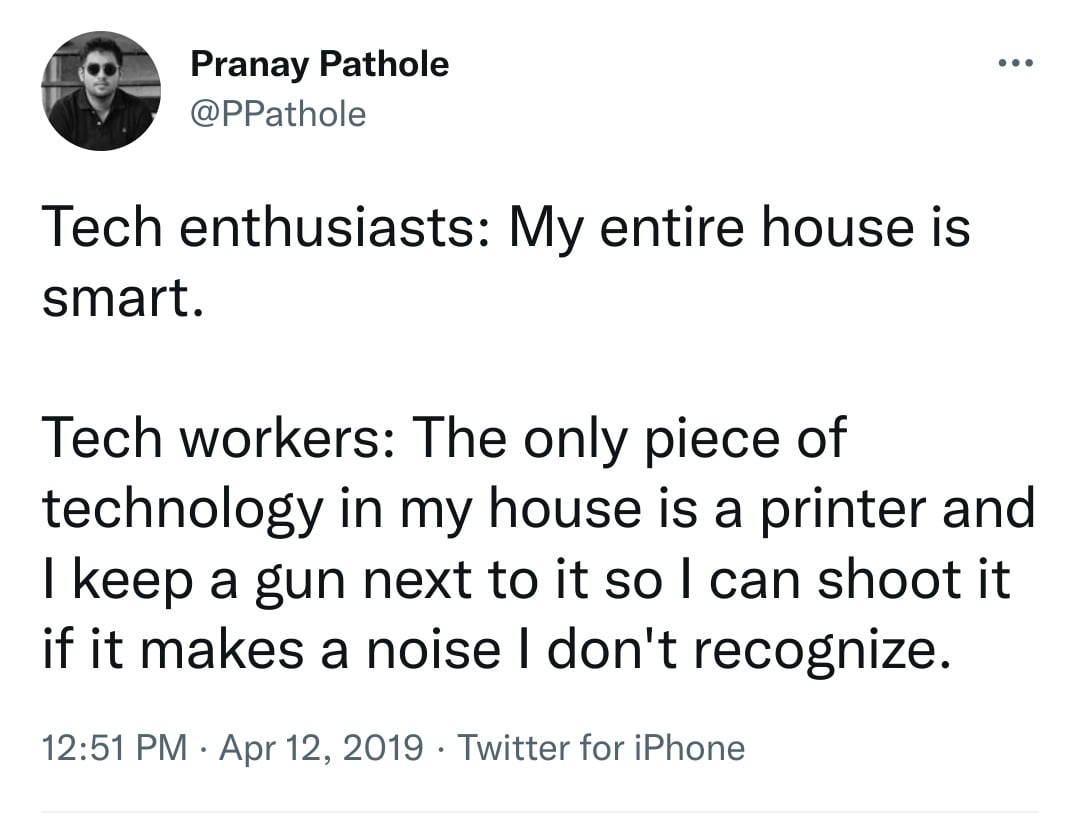
People tweeting stuff. We allow tweets from anyone.
RULES:
Mark NSFW content.
No doxxing people.
Must be a pic of the tweet or similar. No direct links to the tweet.
No international politcs
Be excellent to each other.
Provide an archived link to the tweet (or similar) being shown if it's a major celebrity, figure or any politician. If you replace the "x" at their site with xcancel (so it beomes xcancel.com), and you're not on mobile, it will save video. https://web.archive.org/save is another great option. Archive.is is no longer recommended because they remove/alter content.
If a tweet (or similar) makes a statement of fact, either mark it as "satire" in the body or provide the original source link backing up the statement
Last I checked the only fully open stuff is one manufacturer's IBM power 9 workstation and several Chromebooks
Is it better in embedded stuff? Last openWRT device I ran needed a closed binary for network
There's still some various binaries. E.g. the expressif sdk generated code. However, it's far harder to sneak something nasty into it.
Codespace is at an extreme premium on microcontrollers. Kb, and even bytes matter. A big, complex bit of malware would take significant space, likely enough to be noticed quickly.
As for smaller, simpler malware, this is a possibility. However, due to their nature, microcontrollers get a lot more scrutiny of their outputs. Random data dumps to an unexpected external address would be caught VERY quickly.
This is compounded by the fact that it's not uncommon, at least in larger installs, to segregate IoT devices from the main network. It stops them cluttering it up, and slowing it down. This makes it easy to firewall off the network from the Internet. They can talk to each other, and the central coordinator, but only the coordinator can see the internet, unless explicitly allowed.
If my network were compromised via my smarthome setup, my first suspects would be the debian PC running home assistant, or my ubiquiti router. I've at least reduced my target area to business grade networking kit and a single Linux server. I'm not an impossible target, but far from a soft one.