Mfs seem to have forgotten that Chinese GDP PPP is already higher than the US
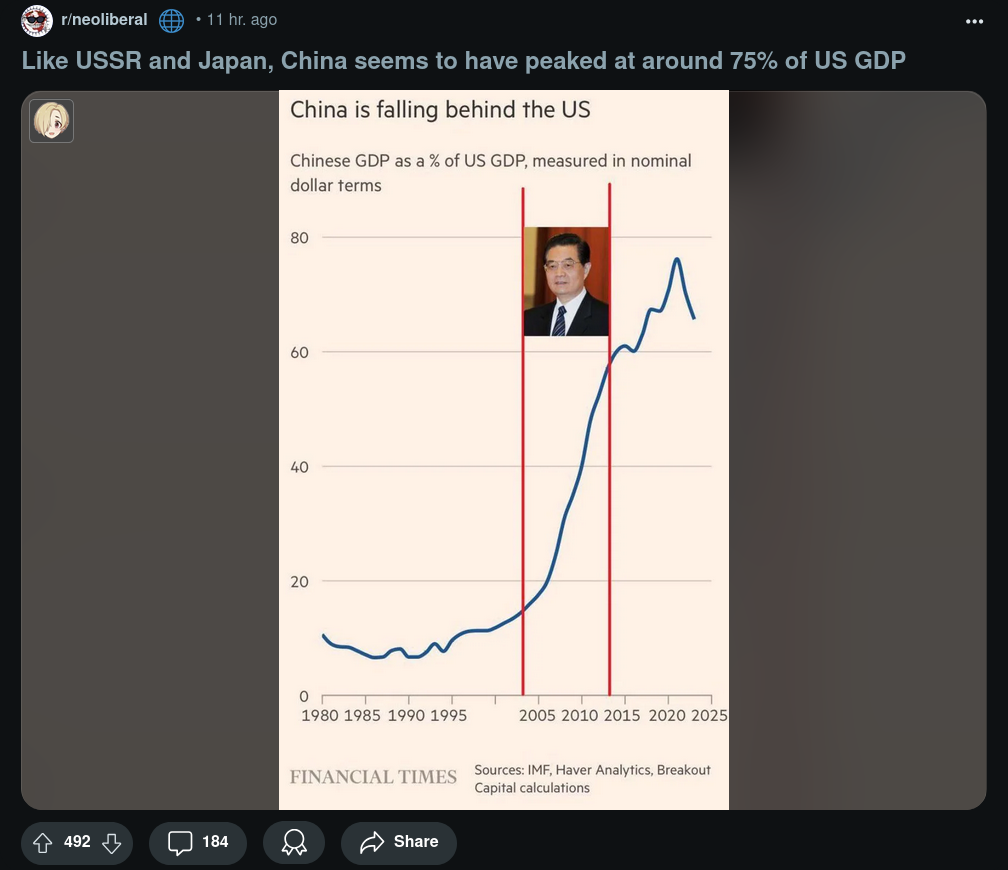
Mfs seem to have forgotten that Chinese GDP PPP is already higher than the US
I really haven't read much of the book, which I should finish ASAP, so I am not really criticizing it, just expressing preliminary concerns.
it says capitalism only becomes systemic to the entire mode of production under the British industrial expansion.
This is kind of my problem here. Capitalism or capitalists are not something that meaningfully exist before the industrial revolution [1]. However, the book talks a lot about capitalist logics of state building, capitalist agencies, capitalist power and so on that existed well before the industrial revolution. This is because capital is conceived of as money with the power of expansion, either through MCM' or MM'.
We also are introduced to Braudel's conception of an anti-market of predators which is "the real home of capitalism". This layer presides over a market layer of "horizontal communications" and "automatic coordination usually links supply, demand and prices". This model seems to contradict the logic of the book, as money has the power of expansion via the market (second layer), and the third layer only emerges after the industrial revolution.
In either case, I feel like the concept of capitalism is being used unclearly. Furthermore, despite quoting Marx quite a bit, the author never even mentions labor value (or exchange value). The amount of focus on wage-labor, agriculture and demographics is also low, which I also find strange given the centrality of these things to any materialist analysis of world-capitalism.
All in all, it seems to me as if this book is about the inter-state politics of capitalism (a fine topic of study, I'm not saying it isn't), but it seems one sided. Maybe reading further in the book will clear things up for me.
[1] Up until that point, almost all of the surplus of any society is the amount of food leftover after all of the peasants/agricultural slaves are fed. This can be used to maintain a buffer, and feed a military/non-food producing portion of the population, but the accumulation of labor value in large quantities over many years can only occur when most of the population is not producing a good which perishes quickly.