1
posts
2
Every day, my genitals "produce" several million sperm — about 1,500 per second.
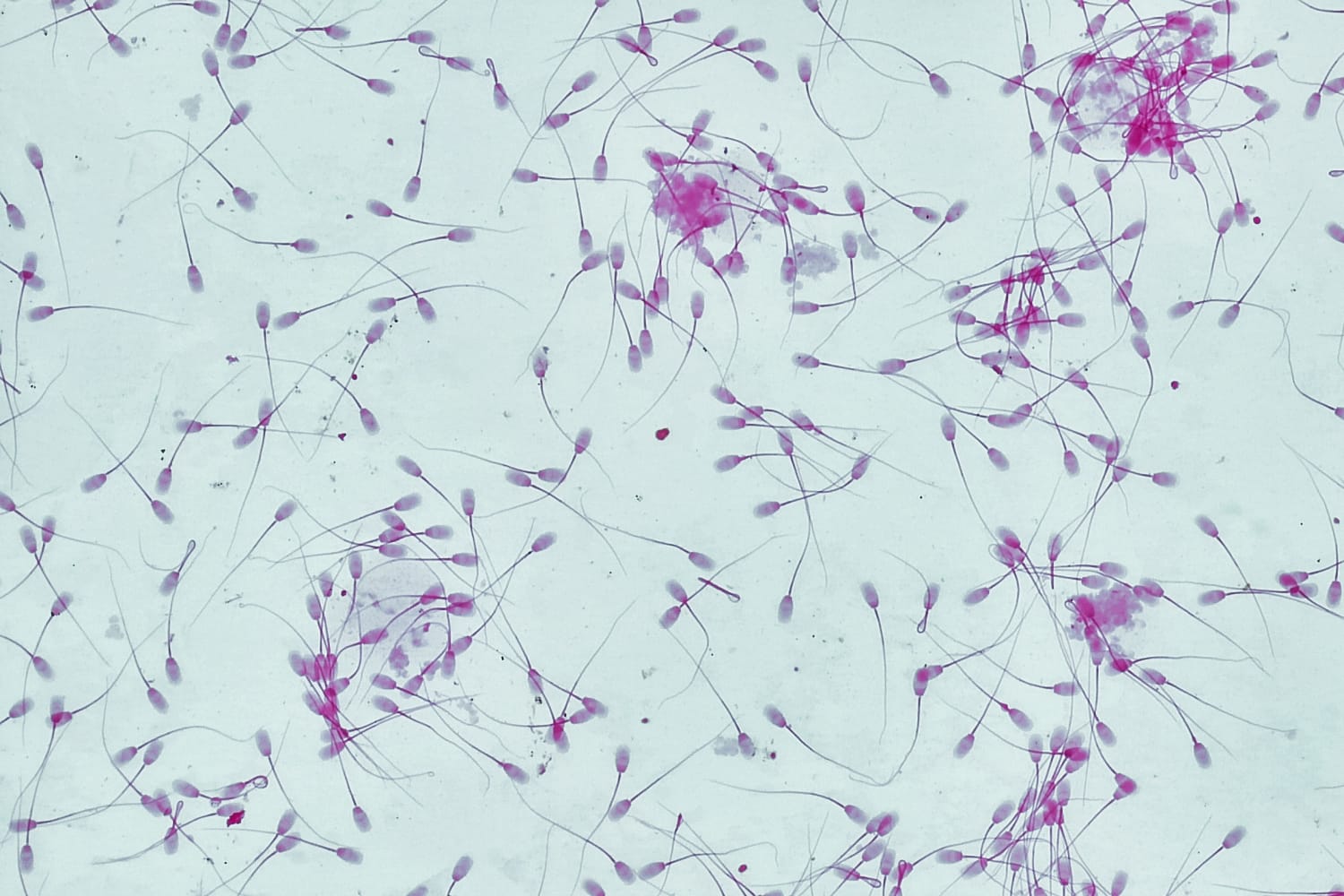
My sperm are BIG... insurrectionist (part of an disorganized militia)... and they have sharp little teeth. They need to be evicted thoroughly and often.
If sperm are not released from the testicles, they die, and their corpses are absorbed. This creates a swampy puddle with sperm swimming in their decomposing peers... and that's sad. I don't like having sad cemetery balls filled with marmy death, so I attempt to give every sperm an adventure - the time of our lives.
Of course, not every sperm is sacred - not every sperm is great - nature attempts to allow for diversity, and often fails.

Each of these individuals (who are also somehow "me") has some amount of autonomy. They each choose to float, swim up, down, left, right, fast, slow, over here, over there, away from the heat, away from that other guy, and at best TOWARD THAT EGG.
Female humans release a relatively passive "egg" - an ovum - about once per month. It attracts sperm, carries genetic information, imposes natural selection, is enveloped by an incubation structure if fertilized, and contributes to the physical body it becomes.

To my perception, it seems as though the ovum is the prototypical "body", and the sperm is the prototypical brain, spine, and central nervous system that enters that "body" - or is accepted by it, or a combination of both - to begin gestation.

This is not "belief" (the acceptance of something without evidence), it is a hypothesis that is based on what I consider to be known about human reproduction and anatomy. I accept that sperm do not have vertebrae... but they do have a "tail" that is remarkably similar to a spine in function and in form - the difference between them is a lack of calcium deposits... "bones".
We are in that respect very similar to the earliest known precursor to all vertebrates - pikaia gracilens.
Fetuses also have early stages that include tail-like forms, and not often, but occasionally, humans are born with vestigial tails that are indications of remnants of early evolution.

I'm just saying... the general shape of the thing... that is... the sperm... seems to reappear during the first two months of gestation, and remains recognizable in the cerebrospinal structure.
"Created YHWH Elohim the sides which had taken from Adam as a wife and brought to Adam."
https://biblehub.com/text/genesis/2-22.htm
The "side chambers" or "sides" (the Hebrew is צְלָעֹת/tsela) that were taken from Adam and made into Eve by YHWH, refer to the side-by-side nature of the testicles.
https://biblehub.com/hebrew/strongs_6763.htm
It does not infer that the testicles or part of the testicles were removed, but that some of the contents of the testicles were used in the creation of Eve. This is a reasonable, non-destructive, somewhat natural perception. To insist that YHWH created Adam whole only to immediately remove part of His creation is extremely problematic.
The essential naturalistic difference between male and female sexual physiology would reasonably be the presence of semen created by males, to early men.
2023 DRHOY asserts - based on indirect observation - that a sperm is a prototypical brain, spine, and central nervous system.
~2010 YouTube atheists (to my experience) give the definitive answer to "Which came first, the chicken or the egg?".
spoiler
Birds - such as the chicken - evolved from lizards, and lizards are also born from eggs.
1978 The first human baby born from in vitro fertilization (IVF).
1916 The first “sperm count” tests were available.
1878 Reproductive cells - egg and sperm - were named "gametes".
~1870 Biologists understood that both sperm and egg are required to produce offspring, but remained largely "Spermist": “The male seed of whatever members of the animal kingdom contains … all the limbs and organs which an animal has when it is born.”
1824 Animal trials were convincing that sperm are not parasites but are involved in fertilization.
1685 It was suggested that inside a sperm’s head was a tiny human body (a "homunculus", blending Ovist and Spermist features).
1651 William Harvey’s On the Generation of Animals states, “Everything from an egg”. "Ovism", the opinions of "Ovists", had a preformist view: there was a ready-made, tiny human being, inside the egg; and inside that human was another egg, enclosing another body, like a hopelessly unnecessary matryoshka doll.
~1590-1650 Microscope users observed minute wriggling living animals in semen. Sperm were generally considered either to be parasites or the sole precursor of a baby ("Spermism"/"Spermists").
c. 1200s Islamic physicians suggest seeds for reproduction are made in several organs and congregate in the sex organs.
c. 65 BCE Roman philosopher and poet Lucretius wrote that men and women produce fluids containing seeds for procreation.
~3000 BCE Enoch began the writing tradition that became what is now Bereshit (Genesis), somehow including an understanding that reproductive influence is located in the testicles.
3
Emperor Rudolph II kept a pet tiger running wild in his castle at all times. People who came to the castle were assured that if the tiger hurt them that the Emperor would reimburse them or their heirs.
I'm just saying... the guy was wild.
Rudolf II inherited the Mira Calligraphiae Monumenta from his grandfather Emperor Ferdinand The First (who had an impressive five-head).

The Mira Calligraphiae Monumenta ("The Model Book of Calligraphy") is a magnificent creation.
It features plants, animals, pretty writing, and many purely fictional fantasties of supernatural things.
The Voynich Manuscript is a... it falls quite short of magnificent... I can say that it is a work of astonishing dedication.
Dedication... to tomfoolery.
It also features plants, animals, and many purely fictional fantasties of supernatural things - including somewhat less pretty (but entirely fraudulent) writing.
https://collections.library.yale.edu/catalog/2002046
It featured the calligraphized signature of E Rudolpnus (that's how he spelled it in the manuscript, not accounting for a few umlauts or whatever) very many dozens of times.
The signatures are generally in the bottom-left of the page, and are occasionally written vertically on its edge.
Rudy had created his own colouring book - very similar to the manuscript his grandfather had given him - and was practicing his signature.
Then, he had a bold idea.
He could convince people that his nonsensical paintings were of archaic - perhaps even alien - origins.
He scraped his signatures and family crest off, weirded the whole thing up with a fake script and a few embellishments, and sent it to a friend.
The friend used a dialect from Malta.
The friend was fooled by the hoax, attempted to equate the symbols within the script to alphabetical characters, and eventually hazarded a guess that the book must be from "West France".
I have now been distracted by the influence of Emperor Rudolpnus' humour for too many hours of my precious life.
From this manuscript, however, I discovered a new form of identification of written characters, and coined them "hydroglyphs".
Hydroglyphs occur when a manuscript gets wet, water stands on the page, ink leaches out of/off of the page, the ink floats on top of the standing water, the water carrying the ink moves, the water carrying the ink dries, and the ink carried by the water re-adheres to the page in a new location (often with a different orientation).
Rudy would have approved of the actual knowledge incidentally gained from his prank.

4